
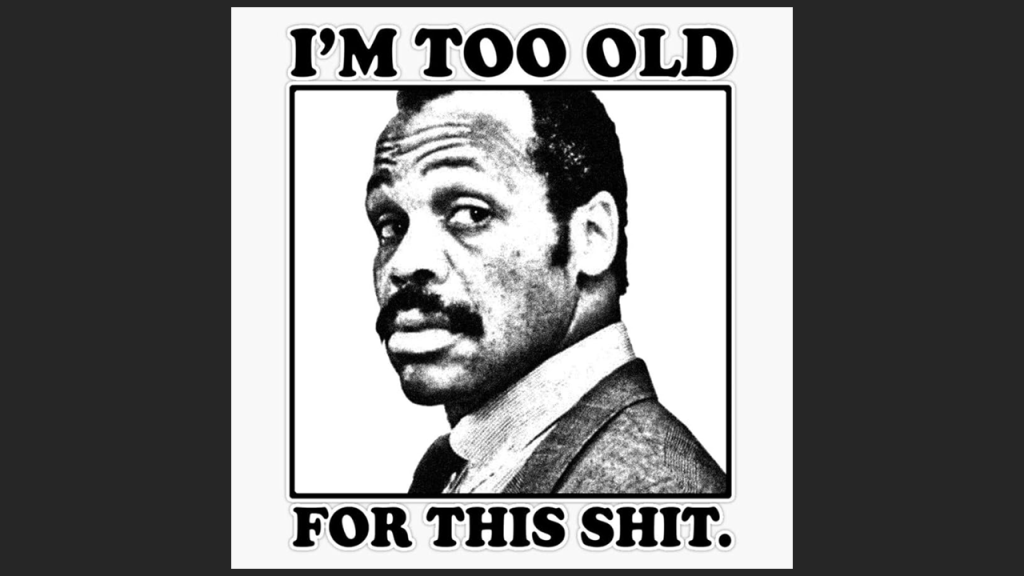
You know the scenes from the Lethal Weapon movies. Roger Murtaugh (Danny Glover) staring down another explosion, car chase or hostage situation, sighs and mutters the immortal line:
“I’m too old for this sh*t.”
(or maybe you haven’t seen Lethal Weapon and I’m too old for this sh*t!)
Either way that’s exactly how I feel every time someone in finance proudly unveils another “self-serve dashboard” to the business.
We spend weeks and months building these interactive masterpieces.
Slicers, drilldowns, heat maps, churn rates, revenue waterfalls, region splits.
There’s probably a KPI in there about how long it took to run if you dig deep enough.
And we launch it with great fanfare. “Now you can answer your own questions!” “We’ve empowered the business!” “Finance is no longer the bottleneck!”
Then the business opens it. Once. Squints at the wall of filters, numbers, and tabs. Then sends us an email saying, “Hey, can you just tell me what’s going on?”
Or they ignore it completely channelling Roger and thinking “I’m too old for this sh*t!”
In theory, these dashboards are meant to be the answer to everything.
We give the business everything we’ve got, structured neatly in Power BI or Tableau, and expect them to dive in and emerge enlightened.
And it frees us up to work on other things.
But there’s a problem – non finance don’t want to dive. They don’t want to swim. They don’t want to snorkel. Most of the time, they already know what’s going on because they’re living it every day. They’re on the floor, in the field, talking to customers, running operations.
They want us to confirm what they already suspect – or better, tell them something they didn’t know.
Do self serve dashboards do that?
Maybe the first one but not the second one. Not without a ton of effort on their part for which they often don’t have the licence to operate.
Self-serve dashboards are, in many cases, just well-packaged data dumps. They look impressive, but to anyone who isn’t in finance, they’re overwhelming, confusing, and honestly a bit annoying.
And a little secret you may or may not know. Our brains are lazy. When given a choice people prefer not to think so when you make them do it Roger Murtaugh’s thoughts arrive.
It’s like giving someone the entire contents of your fridge and pantry and saying, “Make yourself dinner,” when all they wanted was for you to hand them some food and say, “Eat this, it’s exactly what you need right now.”
One thing I learnt in my career is the real value finance brings isn’t in giving people access to everything – it’s in telling them the one or two things that matter.
What’s changed. Why it changed. What it means. What to do about it.
What/Why? So What? Now What?
That’s what they want.
Not a dropdown menu of every possible variable. Not a choose-your-own-adventure data exploration experience. Just clarity.
And that’s the piece we so often miss. Dashboards aren’t bad. They’re just a solution to a problem others don’t have
They’re the appendix to the story, not the headline.
They’re useful to back up a conversation – not replace it.
They’re the thing you send after you’ve already told someone what they need to know.
The business doesn’t need more data. They need more meaning. They need connection – between their activities and the financial outcomes, between what they’re doing and what it’s costing, between what they thought was happening and what’s actually showing up in the numbers.
So build them, sure. But assume nobody uses them unless you also interpret it for them. Talk about what matters. Translate them into something the business can actually use.
Because if your dashboard needs a walkthrough video, then the rest of your business is likely thinking “I’m too old for this sh*t!”





 Finance Business Partnering BLOG