
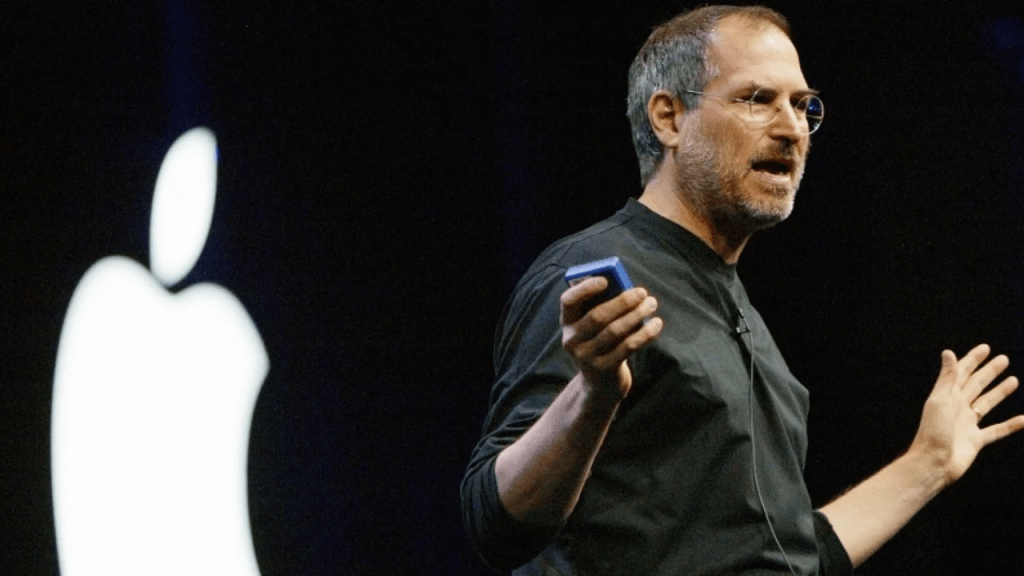
Steve Jobs is one of the most iconic presenters of the last 50 years. Some may say World Class. However people viewed him, and opinions vary, one thing was for sure – when he turned up to Macworld to present Apples new toys, his performances were world class.
What most people don’t know is that Jobs hated presenting. He got nervous like all of us. He felt the pressure. He loathed it. But with the help of his presentation coach he followed a very strict playbook that allowed him to present anything to anyone, land his message every time and have people walk away thinking “World Class again Steve”.
And that process he followed we are going to take you through today….
Step 1 – Start with the Story/Theme
Jobs never opened PowerPoint first. He started with a pen, a wall of sticky notes, and one deceptively simple question:
What’s the one thing I want them to remember?
In finance, this is often where everything goes wrong.
We start with the 47-page deck. Tell everyone everything and then let them decide what they think the key message is. And everyone gets lost
World-class presenters do the opposite. They storyboard first. They define the one key theme. And then – this bit is important – they choose the three things that capture it. Sometimes one, sometimes two but never more than three.
Your audience can only remember three things. They cannot remember the entire general ledger history of the Asia-Pacific region.
Take the famous “1,000 songs in your pocket” moment. He didn’t say:
☠️ We’ve achieved a 5GB miniaturised hard drive,
☠️ With a breakthrough battery architecture,
☠️ Supported by proprietary software
No. He crafted a theme. Then he distilled it into a single unforgettable line.
And if you’re thinking, “Yes Andrew, but my finance update isn’t a product launch,” let me stop you. It absolutely is. You’re launching ideas, decisions, trade-offs, stories about the business. Things you want people to remember.
If you can’t summarise your update in one crisp theme and three supporting ideas, the problem isn’t that finance is complex – it’s that the message hasn’t been shaped yet.
Step 2 – Write out your script
Once your storyboard is clear, the next step is wonderfully unglamorous: Write. It. Down.
All of it. Everything in your head. The messy version. The director’s cut. The stuff that definitely won’t make it into the final performance but needs to be on paper so you can see what you’re actually dealing with.
Jobs famously wrote out entire scripts.
He didn’t wing it. He didn’t improvise. He didn’t let inspiration strike five minutes before go-time.
And here’s why this matters for finance. When you write out your script….
✌ You spot the jargon you shouldn’t use.
✌ You discover the rabbit holes you absolutely shouldn’t explore.
✌ You see the story emerging instead of the numbers fighting for airtime.
When people tell me, “But Andrew, I don’t have time to write a script,” I simply say “if you don’t have time to clarify your thinking, you definitely don’t have time to confuse your audience”
Step 3 – Practice saying it
Here’s where the myth meets the man.
Jobs didn’t just rehearse. He trained. He treated presentations the way athletes treat competition. Hours and hours and hours. And then more hours.
He practiced until the story felt instinctive. And guess what happened during all that practice? He cut, refined, tightened, sharpened.
Practice wasn’t about memorising a script.
Practice was about discovering the best version of the message.
You’ll find the same thing. The first time you say your script out loud, you’ll immediately hear what doesn’t work. The second time, you’ll delete whole sections. By the fifth run-through, you’ll wonder why you ever thought you needed that long-winded explanation of EBITDA variances between Q2 and Q3.
The more you practice, the shorter and sharper the message becomes.
And the shorter and sharper the message becomes, the more your audience will thank you – possibly with applause, but more likely with fewer follow-up questions.
If you want a behind-the-scenes example: before the presentation where he pulled the MacBook Air out of an envelope, he practised that single moment dozens of times. Not the slide. Not the narrative. The moment. Because he knew the audience would remember how he made them feel far more than what he said.
That’s the power of practice. It reveals what matters.
Step 4 – Prepare your slides
Only now do the slides appear.
Most people create slides before they even know what they’re talking about. Pull them all together (usually just replacing last months version), write some notes on the note section and just read through it.
That’s like decorating a cake before you’ve baked it.
Slides are not your message.
Slides are not your notes.
Slides are not your safety net.
Slides are simply visuals that support what you’re saying.
Your audience wants you to present. Not read what you are going to say. If they wanted that just send the pre read and say “If you’ve got any questions, just ask”
Jobs often used slides with nothing but a single word. Or a giant photo. Or just one number. Because the slide wasn’t meant to carry the meaning, he was
Finance tends to do this backwards. We cram everything onto the slide and then apologise for how busy it looks. Instead, try this: now that you’ve storyboarded, scripted, and practised, create slides that do nothing more than reinforce your message.
A simple picture, one number…..big…..a quote.
And if detail is needed put it in a pre read or an appendix.
Your slides should feel like background singers, not lead vocalists.
Step 5 – Rehearse, rehearse, rehearse
This is different from step three. Step three is about shaping the message.
Step five is about delivering it flawlessly.
Rehearse until you know it. Until you don’t need notes. Until the pauses feel natural. Until the transitions glide. Until your body language matches your intention.
Jobs didn’t read from slides because he didn’t need to. He wasn’t presenting information – he was sharing a story he had internalised.
And that’s exactly how you become a world-class communicator in finance. Not by knowing the numbers – everyone expects that – but by owning the narrative.
Rehearse until the message becomes muscle memory. Because when it does, everything changes:
💪 You look more confident.
💪 You sound more credible.
💪 You connect more deeply.
💪 You influence more effectively.
And isn’t that the whole point? To move people? To shape a decision? To help your business do something tomorrow that it wouldn’t have done without your insight today?
You don’t need a turtleneck.
You don’t need a stage with theatrical lighting.
You don’t even need a new MacBook – I use a HP in case you were wondering.
You just need a process.
Storyboard. Script. Practice. Slides. Rehearse.
It worked for Jobs.
It works for the best presenters in the world.
And it will absolutely work for you



 Finance Business Partnering BLOG